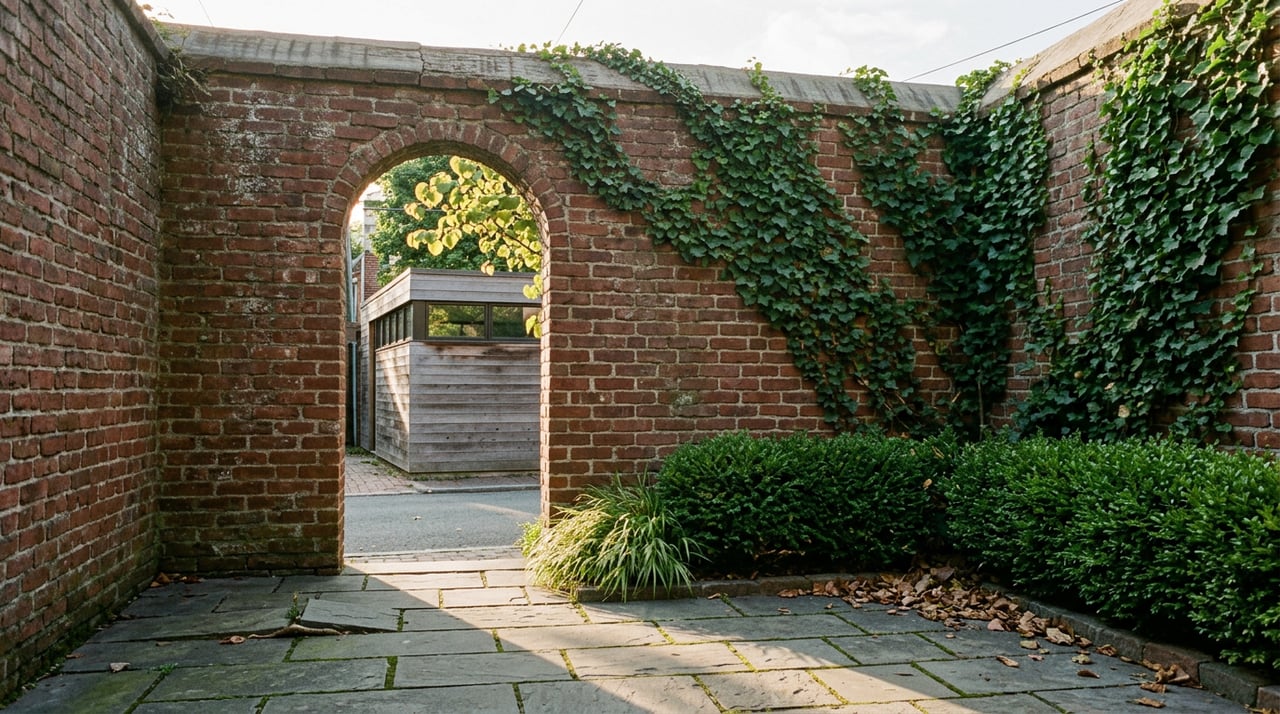
As Washingtonian reported, Jack Becker was priced out of Capitol Hill during the pandemic. He and his now-wife, Maddie Hoagland-Hanson, wanted to trade his Anacostia Victorian for something they could shape themselves, and the rowhouse market on the Hill wasn't going to let them do that on a normal budget. So Becker, an architect, did something most buyers never consider: he built behind the market instead of in it, putting up a house on a vacant lot that faced not a street but an alley a few blocks north of Lincoln Park.
The lot had a problem before it had a foundation. The alley it sat on had no official name, and without a name it couldn't get a legal address. Becker had to petition his Advisory Neighborhood Commission, get half his neighbors on board with a resolution, and choose a name before the postal system would even recognize the place existed. He picked Overbeck, honoring Ruth Ann Overbeck, the historian who helped establish the Capitol Hill Historic District in the first place. His house went up next to it. A developer named J.D. Schmidt later built a second house on the adjoining lot, using the same architectural plans Becker had drawn, and listed it for $2.5 million in the fall of 2025. Becker calls his own place OB One. Schmidt's is OB Two.
That story sounds like a quirky footnote. It is actually a preview of something structural that changed for Capitol Hill this year, and it matters for anyone evaluating the neighborhood as a place to buy, whether you're eyeing a classic rowhouse on a numbered street or wondering what's really behind it.
Capitol Hill's pitch to buyers has always leaned on scarcity. The historic district is enormous, roughly 8,000 contributing buildings across the largest single historic district in the city, and the conventional wisdom is that there's no room left to build anything new inside it. That's true if you're only looking at street frontage. It stops being true the moment you look at the alleys.
DC's Office of Planning has been counting these lots, and the count is bigger than most buyers assume. The city has an estimated 1,897 alley lots total, parcels with no street frontage at all, accessible only from an alley. Of those, roughly 890 sit vacant, and slightly more than 500 are large enough to support a house. The highest concentrations of genuinely buildable alley land are in Georgetown, Eckington, Capitol Hill, and Petworth. Broken down by Advisory Neighborhood Commission, ANC 6B, which covers a large stretch of Capitol Hill, has more alley lots than any other ANC in the entire city: 198 of them.
That number is the whole story in miniature. Capitol Hill isn't short on infill opportunity. It's short on infill opportunity that shows up in a normal property search, because an alley lot with no address doesn't show up on a map the way a rowhouse with a street number does. The supply is real. It's just invisible until someone goes looking for it, the way Becker did.
The zoning rules governing these lots had been mostly frozen since a 2016 rewrite first allowed accessory dwelling units on alley lots, as DCist reported. This year, the Office of Planning pushed through a more significant update. The proposal went to the Zoning Commission in May 2025, came back revised in January and again in March 2026, and the final version was approved and published in the DC Register in July 2026.
As Teass-Warren explains, here's what it actually does, compared with what came before:
| Before | As of July 2026 | |
|---|---|---|
| Matter-of-right height limit for alley buildings | 20 feet | 25 feet |
| Minimum alley width to subdivide as of right | 24 feet | Still 24 feet |
| Subdividing a narrower alley lot | Not permitted | Allowed via a new BZA special exception, with referral to FEMS, DDOT, and DC Water |
The height increase is the clean win. Five extra feet doesn't sound like much, but architects who worked on the case argued it's the difference between a slab-on-grade house sitting at alley level and one with enough of a raised foundation or crawl space to put real separation between living space and alley traffic. That's now the rule everywhere alley construction is allowed, no hearing required.
The subdivision change is where the story gets more interesting, and where a lot of the coverage oversimplified things. Planners originally proposed dropping the matter-of-right width for subdivision from 24 feet to 15 feet, which would have opened up a meaningful share of the city's older, narrower alleys, including many on Capitol Hill, without any discretionary review. That piece got pulled before the final vote. What survived is a special exception path: a narrow alley lot can still subdivide, but only by going through the Board of Zoning Adjustment, with sign-off required from the fire department, transportation, and the water utility.
That distinction matters if you're trying to figure out what this means for a specific block. Capitol Hill's oldest alleys, places like Gessford Court and F Street Terrace, which still hold original 19th-century alley dwellings identified in a 1912 citywide survey, tend to run narrower than the newer service alleys built for garages and delivery access. Those older, tighter alleys are exactly the ones that still need a hearing rather than getting a rubber stamp. The reform didn't open a floodgate. It opened a slower, more selective door, and it's going to favor the wider alleys over the historic ones for a while.
If you're weighing Capitol Hill against another historic DC neighborhood, the alley lot count changes what "limited supply" actually means here. In a neighborhood with almost no alley inventory, the housing stock you see is close to the housing stock you'll ever get, and price is driven almost entirely by what already exists. Capitol Hill isn't that neighborhood. It has a documented pool of vacant, technically buildable land sitting behind rowhouses that already look fully built out from the street.
That cuts two ways for a buyer. If you're purchasing a rowhouse that backs onto one of these wider, more viable alleys, you should assume there's a real chance of new construction appearing behind you within the next several years, not decades. Overbeck Alley wasn't a one-off. It's the kind of project the current rules were specifically revised to make more common. On the other hand, if you're specifically looking for a project, a rear lot with alley access that's wide enough to clear the 24-foot matter-of-right threshold is now a meaningfully more valuable asset than it was a year ago, because the height change alone makes a small footprint pencil out better than it used to.
Either way, the historic district doesn't disappear from the equation just because zoning loosened.
If you're looking at a Capitol Hill property with meaningful rear alley frontage, whether you're buying the main house or considering the lot itself, a few questions are worth asking before you get too far into the process:
None of these questions show up in a standard listing description, and they won't come up in a typical showing unless someone thinks to ask.
Capitol Hill's story has always been about depth: block-by-block character, architectural texture, the sense that everything worth knowing is already visible from the sidewalk. The alleys are the part of that story that isn't visible from the sidewalk, and this year they became a little more relevant to what your property is actually worth, or what it could become.
If you're evaluating a Capitol Hill purchase or sale and want a read on what's happening behind a specific address, not just on it, Conway Group can walk through the details with you. Schedule your neighborhood consultation and let's look at the whole lot, not just the front of it.
This article is general information, not legal, tax or financial advice. Consult a qualified professional about your situation.
With an extensive network at their fingertips, the Conway Group has developed trusted relationships to provide a streamlined experience from start to finish, while keeping clients at the forefront of every step toward success.
Contact UsAddress
5471 Wisconsin Ave., #300
Chevy Chase, MD 20815