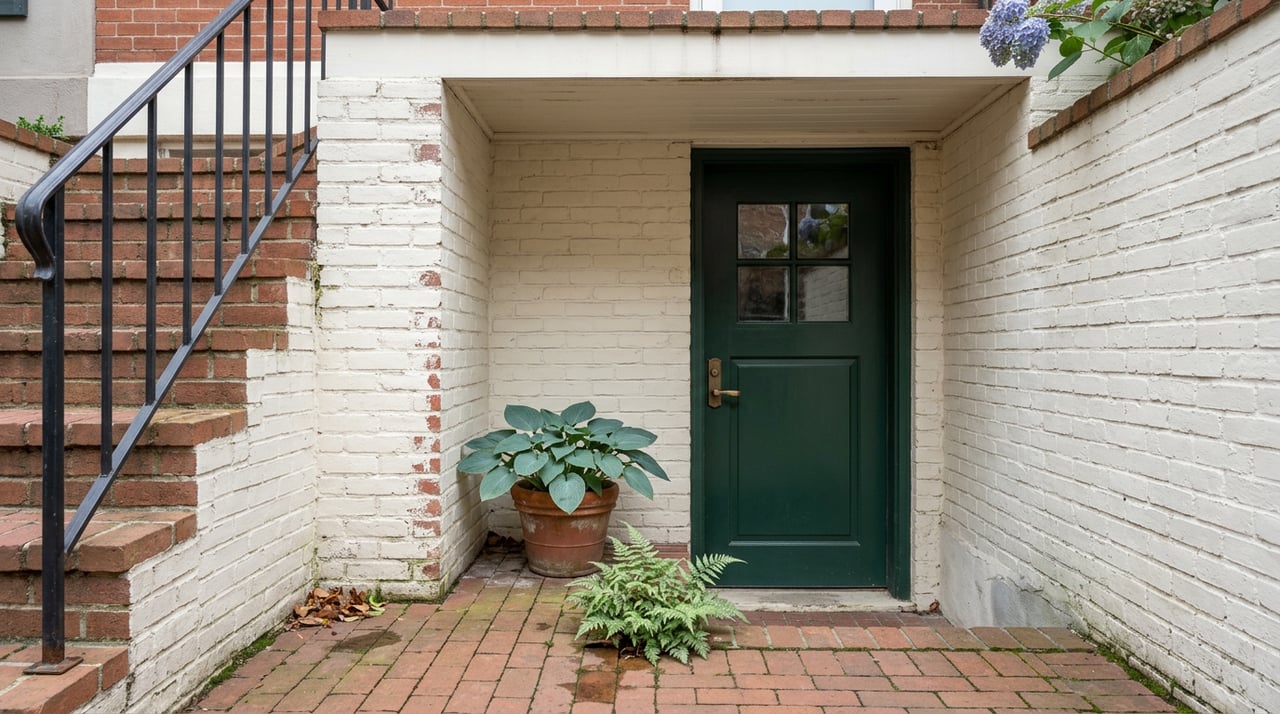
When PoPville ran its August 19 roundup of new listings, one line on 809 Delafield Place NW caught the eye of anyone shopping Petworth for cash flow: the finished basement was pitched as rental income or an in-law suite. That phrase does real work. It tells a buyer the space exists, finished and functional. It does not tell them whether they can legally hand someone a key and start collecting rent the week they close.
That gap between a basement that looks like a rental and a basement that legally is one is where most Petworth buyers get surprised. Not because the zoning says no. In Petworth, zoning almost always says yes. The surprise shows up later, buried in a permit file most buyers never think to ask for before they write an offer.
According to Petworth News, most of Petworth sits in the RF-1 zone, a designation that swept across much of the neighborhood during DC's 2016 zoning overhaul, when many blocks shifted out of the older R-4 classification. Under RF-1, a lot is allowed two principal dwelling units as a matter of right. No board hearing, no special exception, no requirement that the owner live upstairs. Matter of right means exactly that: you meet the physical standard and you're done asking permission.
That last part is what separates Petworth from a lot of nearby DC neighborhoods. In lower-density R zones, the kind that cover parts of Cleveland Park, the same basement would fall under DC's accessory apartment rules rather than the flat rules. Those rules require the owner to live in either the main house or the basement unit, a condition the code does not allow anyone to waive. That single requirement rules out most pure investment plays in DC's lower-density zones. Petworth's RF-1 status is a big part of why the neighborhood functions as a base for small-scale investors who have no intention of living in the building at all.
| R-1/R-2 Zones, accessory apartment | RF-1 Zone, two-unit flat | |
|---|---|---|
| Legal framework | Subtitle U, Section 253 | Subtitle U, Section 301 |
| Owner must live on site | Yes, cannot be waived | No |
| Principal units allowed | One, plus one accessory unit | Two, with equal legal standing |
| Certificate of Occupancy required | Yes | Yes |
| Where you'll find it in Petworth | Rare, most blocks rezoned out of this in 2016 | Most of the neighborhood |
Here's the part that trips people up. Matter-of-right zoning doesn't issue a Certificate of Occupancy. Nomadic Real Estate says that certificate is tied to the physical unit, and it needs to be reestablished when a home changes owners, not carried forward automatically from the seller's paperwork. A basement can have generated rent for the previous owner for years, appeared in their tax filings, and shown up looking finished in every listing photo, and still not transfer to you as a legal rental without a new application.
Compare the language on two real Petworth listings. The 809 Delafield description leans careful: the basement is described as providing valuable additional living space, perfect for extended family, long-term guests, or potential rental income. Contrast that with a listing for 950 Shepherd Street, which describes a full income-generating lower level unit with a separate Certificate of Occupancy. That phrase, separate Certificate of Occupancy, is the tell. It means someone already went through the Department of Buildings' process and has paper to prove it. The absence of that phrase on a listing doesn't mean the unit is illegal. It means you're the one who has to go find out.
The physical standards are their own filter. DC's building code sets a 7-foot minimum ceiling height for habitable basement space, with a narrower allowance of 6 feet 8 inches under beams and ducts. Petworth's housing stock dates largely to the streetcar-driven building boom that ran from 1890 into the early 1940s, and a lot of those basements were framed for storage, not for people, which means plenty of them don't clear that bar without excavation. Bedrooms also need to meet applicable requirements. And DC's fire code calls for roughly one hour of fire-rated separation between the two units, typically achieved with rated drywall. That's a simple add in an open, unfinished basement and a considerably more disruptive one once someone has already closed up the ceiling with recessed lighting and finished drywall.
Once a basement clears all of that, the math starts to matter. Current Petworth basement rentals span a real range: a furnished basement apartment listed around $1,350 a month on one end, and a fully renovated English basement apartment with its own front and back entrances on Buchanan Street NW listed near $2,250 on the other.
A local house-hacking analysis modeled three outcomes for a Petworth rowhouse owner running a basement rental. In a conservative scenario, the unit nets roughly $960 to $1,080 a month after 10 to 20 percent in operating costs, covering about 23 to 26 percent of total housing expense. A moderate scenario nets closer to $1,360 a month, about 33 percent of housing cost, after 15 percent expenses. The top scenario, built specifically around a fully legal two-bedroom renting near $2,000 a month, nets around $1,700, offsetting 41 percent of the owner's housing cost.
Notice the word doing the heavy lifting in that top scenario. The analysis didn't model "a nice finished basement." It modeled a fully legal one. Everything below that top tier assumes some combination of vacancy risk, deferred permit costs, or a unit that can't command top rent because it's missing a feature the code requires.
Here's where the market data gets genuinely interesting for anyone shopping this specific asset. Zillow's average home value for Petworth, updated July 31, 2026, stood at $639,834, down 1.3 percent over the prior year. Redfin's median sale price for the neighborhood in March 2026 was $800,000. That's a gap of more than $160,000 between two figures both labeled the Petworth home price.
The gap isn't a data error. Zillow's average blends every property type the index tracks, condos and co-ops alongside rowhouses, while Redfin's median reflects only homes that actually closed, a set that skews toward the rowhouse stock. If you're specifically shopping for an RF-1 rowhouse with a basement that's already permitted or realistically convertible, the blended average understates what you'll actually pay. The median is the more honest anchor, and even that figure covers a mixed bag: some homes selling with a documented income unit already in place, others selling with a basement that's finished, photogenic, and still years from a Certificate of Occupancy.
Does the seller have to disclose that the basement rental was never permitted? DC requires disclosure of known material defects, but an unpermitted rental doesn't always register as a defect in a seller's mind if the space quietly generated income for years without issue. Ask the question directly and get the answer in writing rather than assuming silence means yes.
What if I'd rather run the unit as a short-term rental instead of a long-term lease? Short-term rentals run on a separate DC framework tied to the host's primary residence, with its own registration and licensing track apart from the two-unit flat rules described here. Qualifying as a legal RF-1 flat for a long-term lease doesn't automatically clear you for nightly stays.
Can I live in the basement myself and rent out the main house instead? Under RF-1, yes. Both units carry equal legal standing, and neither one requires the owner to occupy it. That flexibility is one of the more useful, and least advertised, features of buying into this particular zone.
A finished basement and a legal one are two different products wearing the same listing photos. If you're weighing a Petworth rowhouse for exactly this reason, Conway Group can walk the permit history with you before you're three weeks into a contract. Schedule your neighborhood consultation and bring the listing. We'll tell you what the paperwork actually says.
This article is general information, not legal, tax or financial advice. Consult a qualified professional about your situation.
With an extensive network at their fingertips, the Conway Group has developed trusted relationships to provide a streamlined experience from start to finish, while keeping clients at the forefront of every step toward success.
Contact UsAddress
5471 Wisconsin Ave., #300
Chevy Chase, MD 20815